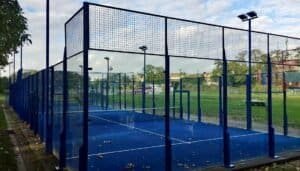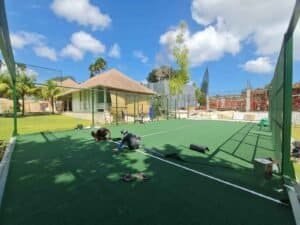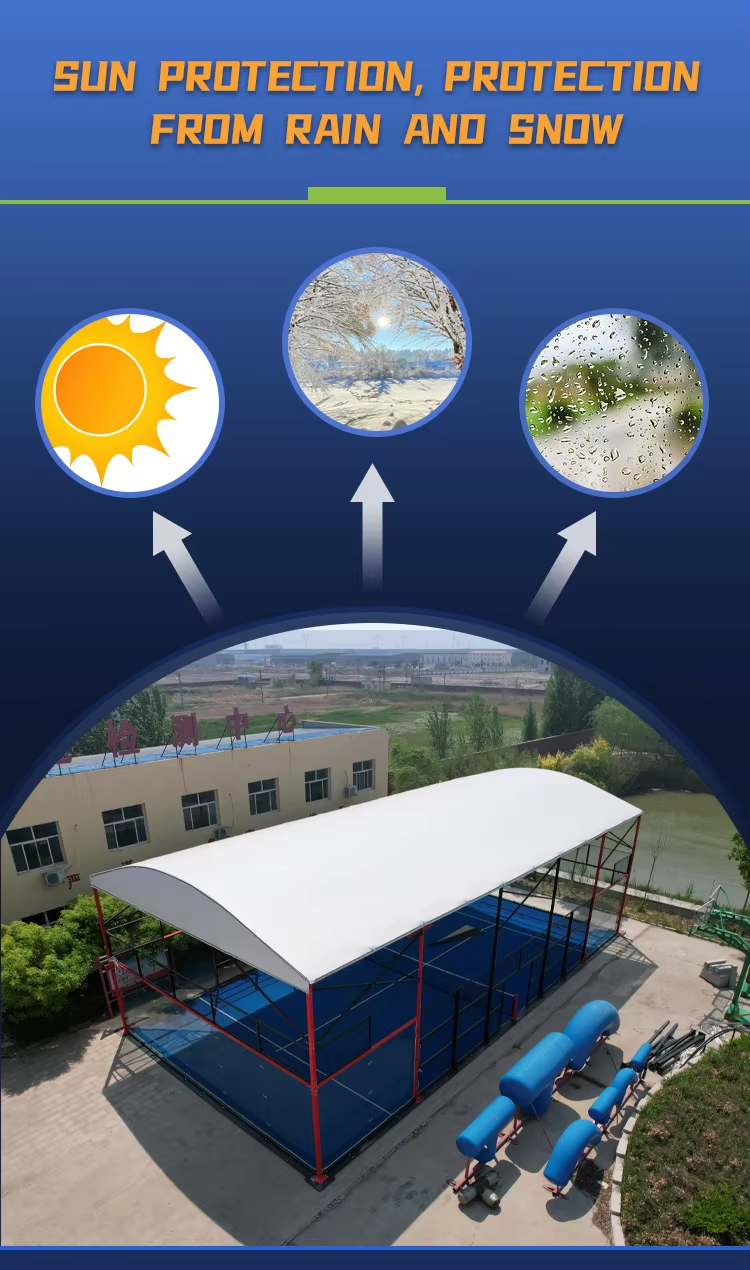
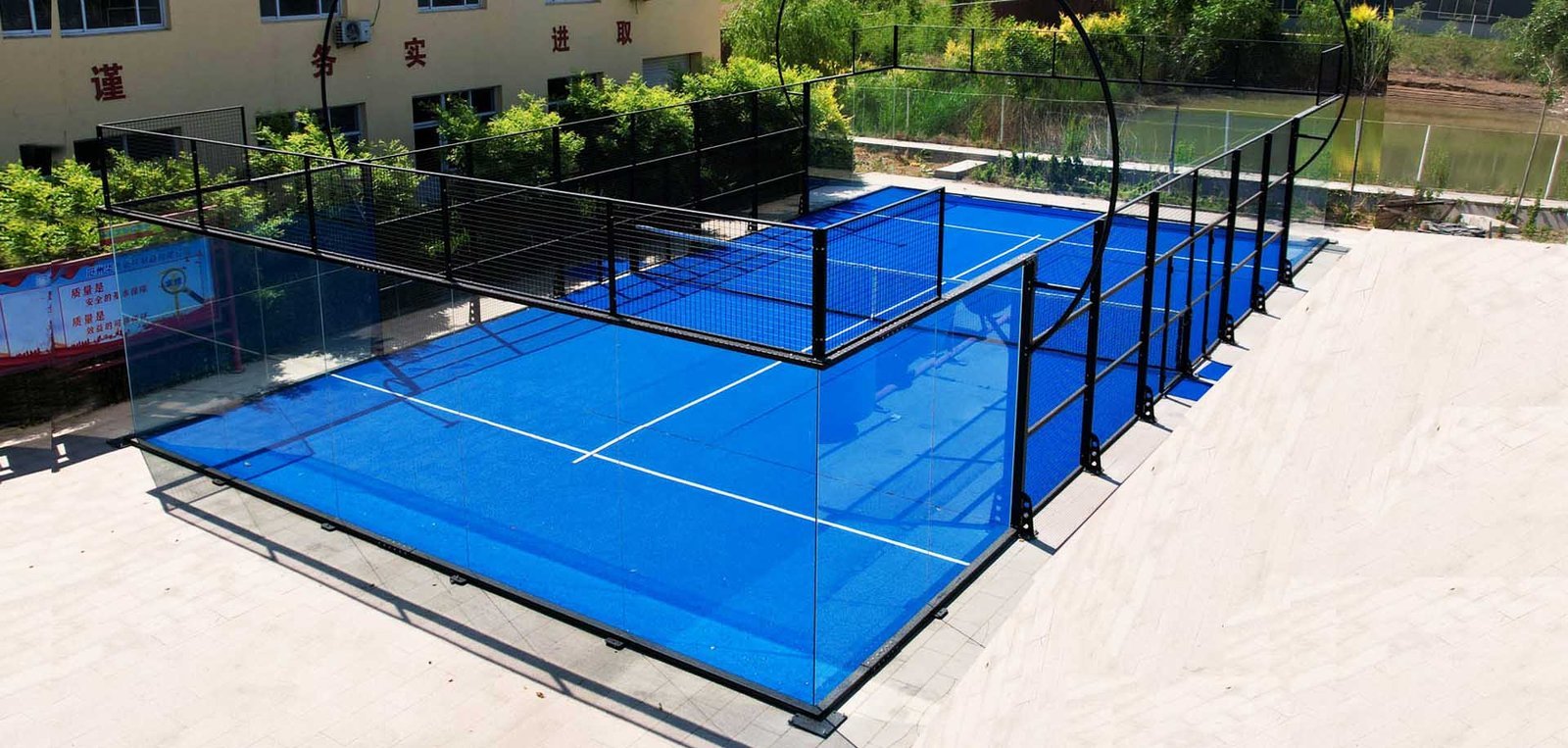
It uses the same standard playing dimensions and follows the same basic playing rules as other padel courts. The main difference is the structural design around the glass enclosure.
A panoramic padel court is a padel court design that reduces visible structural supports around the main glass viewing areas to provide a wider and cleaner spectator view.
For buyers planning a commercial padel project, the important question is not simply whether a panoramic court looks better. It is whether a Classic, Panoramic or Full Panoramic court is the right match for the project budget, venue positioning and spectator requirements.
Classic, Panoramic and Full Panoramic: The Main Difference
The easiest way to understand the three court types is by looking at how much structural framing remains around the glass enclosure.
Classic Padel Court
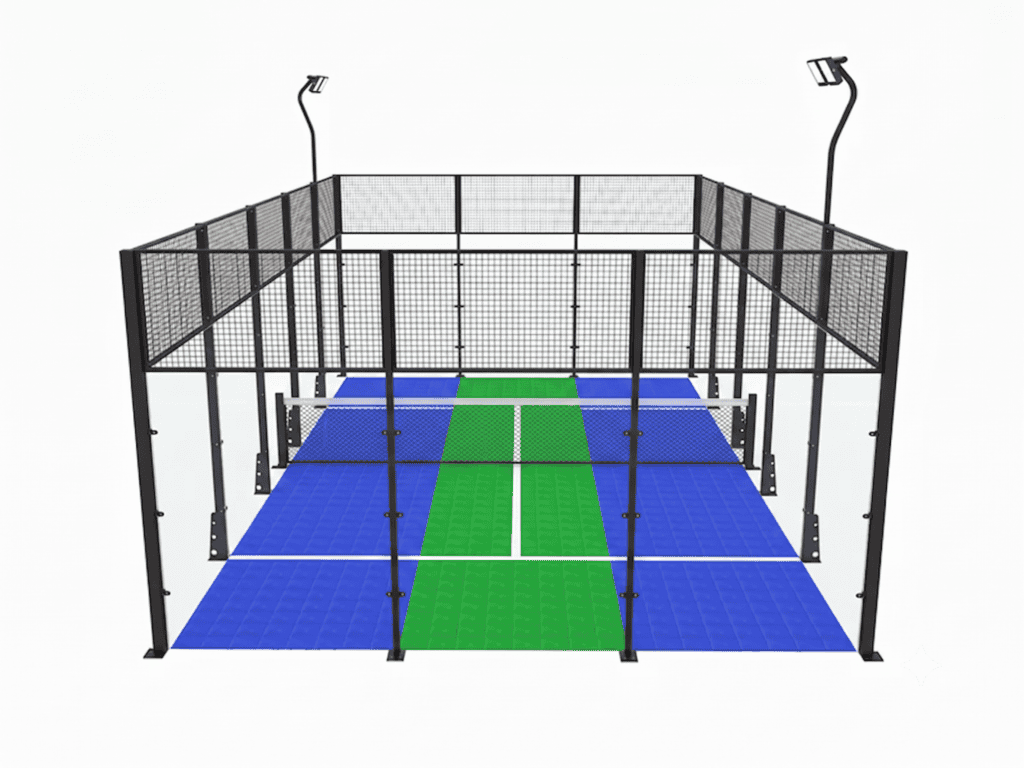
A Classic Padel Court uses a traditional framed structure with more visible steel posts around the glass and fencing sections.
It is the most practical option for projects where structural simplicity and budget control are more important than maximum spectator visibility.
Best suited for:
- Training centers
- Schools
- Community sports facilities
- Budget-focused clubs
- Multi-court projects where cost efficiency is important
Main advantage:
Cost-effective traditional structure.
Panoramic Padel Court
A Panoramic Padel Court reduces the number of visible structural supports around the main glass viewing area.
Compared with a Classic Court, spectators have a wider view of the playing area while the structure still retains additional support points.
This makes the Panoramic Court a balanced option between cost, structural design and visual presentation.
Best suited for:
- Commercial padel clubs
- Indoor padel centers
- Multi-court facilities
- Resorts
- Projects where spectator visibility matters
- Clubs seeking a more modern appearance
Main advantage:
Balanced visibility, structure and project cost.
Full Panoramic Padel Court
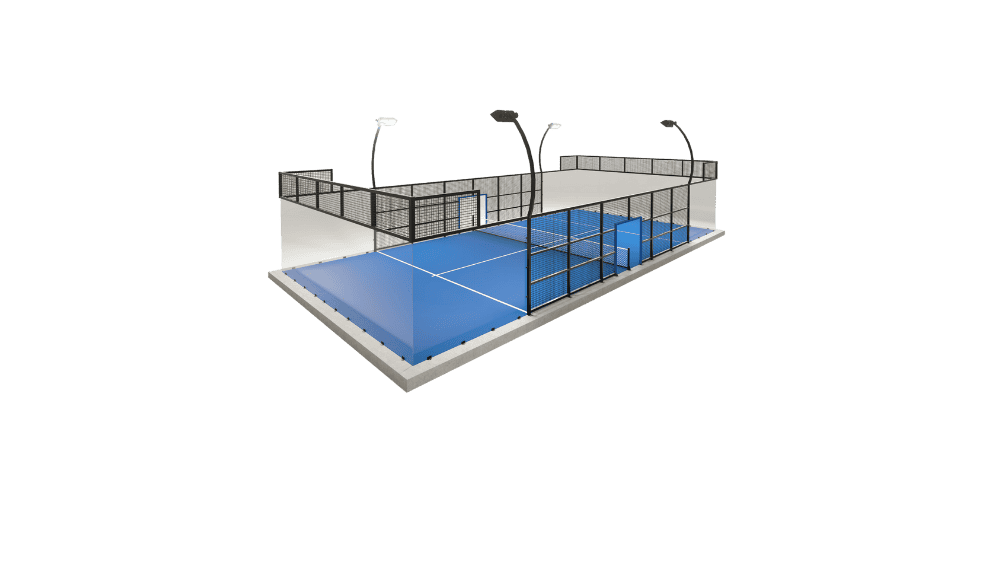
A Full Panoramic Padel Court takes the panoramic concept further by minimizing structural obstruction around the main viewing areas.
This produces a cleaner visual appearance and gives spectators, cameras and club visitors a wider view of the court.
It is generally positioned as the premium option among the three main structural designs.
Best suited for:
- Premium padel clubs
- Show courts
- Flagship projects
- High-end resorts
- Event-oriented venues
- Projects where visual presentation is a priority
Main advantage:
Maximum spectator visibility and premium presentation.
Classic vs Panoramic vs Full Panoramic Padel Court
| Feature | Classic | Panoramic | Full Panoramic |
|---|---|---|---|
| Structural Framing | More visible steel supports | Reduced support structure | Minimum visual obstruction |
| Spectator Visibility | Standard | Wide panoramic view | Maximum viewing area |
| Appearance | Traditional | Modern | Premium |
| Cost Position | Cost-effective | Mid-range | Premium |
| Typical Buyer | Budget-focused operator | Commercial club | Premium / flagship venue |
| Multi-Court Projects | Excellent | Excellent | Suitable |
| Show Court Application | Basic | Good | Excellent |
| Commercial Clubs | Yes | Yes | Yes |
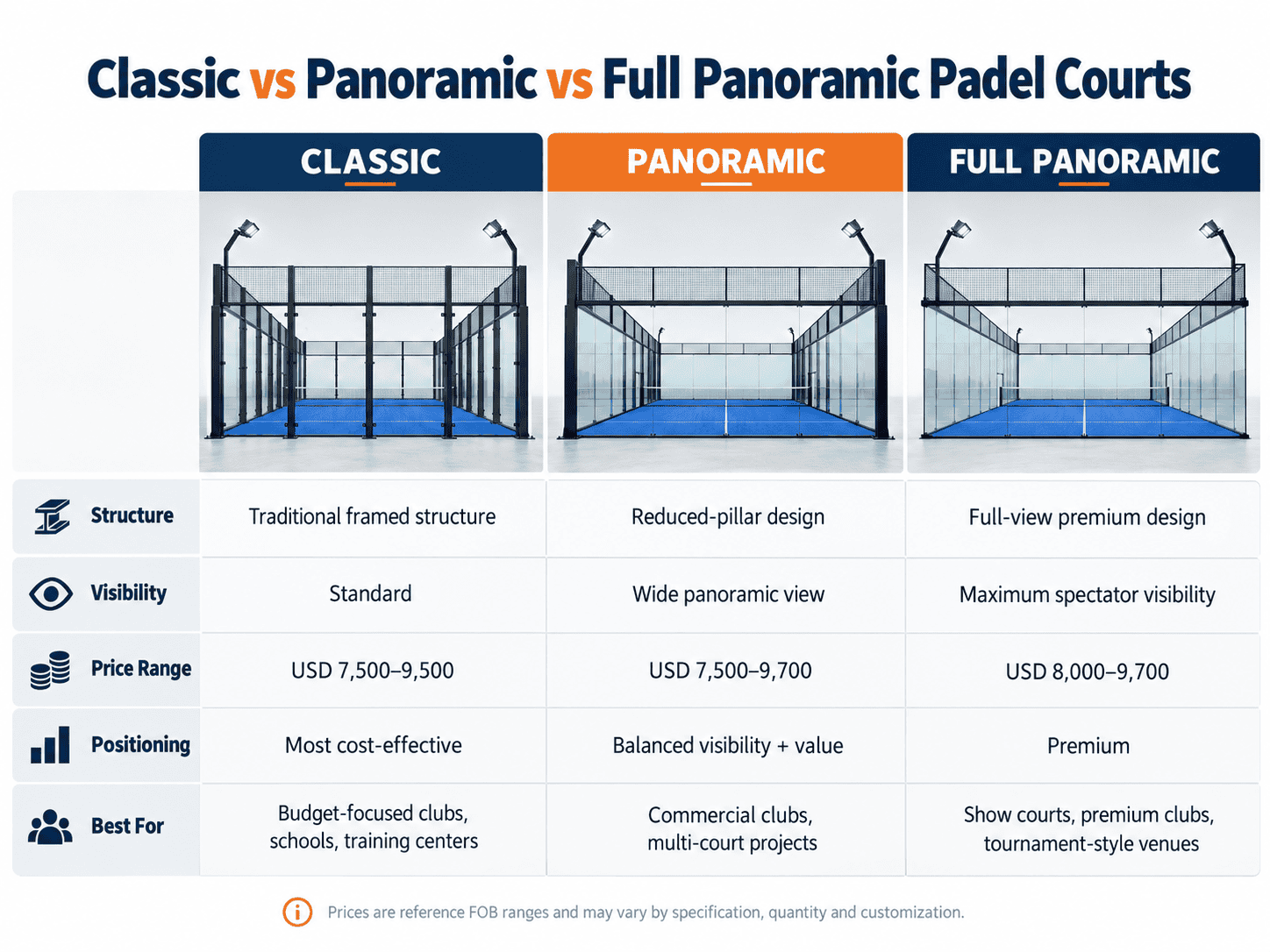
The correct choice depends on the facility rather than simply choosing the most expensive design.
Which Padel Court Type Is Best for Your Project?
There is no single court type that is best for every project.
The right choice depends on the main commercial objective of the venue.
Choose a Classic Court If Cost Control Is the Priority
A Classic Padel Court is often the most practical option when a project needs several courts and the buyer wants to control the initial investment.
For example, a training center planning six courts may prefer to spend more of its budget on additional courts, club facilities or player services rather than premium court aesthetics.
Classic courts are also suitable where spectator viewing is not the main commercial priority.
Typical project profile:
High court quantity + controlled budget + daily commercial operation.
Choose a Panoramic Court for Most Commercial Clubs
For many commercial padel clubs, the Panoramic Court provides the strongest balance.
It improves spectator visibility and gives the venue a more modern appearance without necessarily moving to the highest-level premium structural design.
This makes it suitable for clubs where the court itself is part of the customer experience.
Panoramic courts can work particularly well when several courts are installed together because players, visitors and staff have clearer visibility across the facility.
Typical project profile:
Commercial club + good presentation + controlled investment.
Choose Full Panoramic for Premium and Showcase Projects
A Full Panoramic Court makes the most sense when visual presentation is an important part of the business model.
For example:
- A premium club may use it as the main show court.
- A resort may place it in a highly visible location.
- A commercial facility may use one Full Panoramic Court for events while installing Panoramic or Classic Courts for regular daily play.
This means a project does not necessarily need every court to use the same structural design.
Typical project profile:
Flagship venue + spectator experience + premium branding.
Can a Club Use Different Court Types in the Same Facility?
Yes.
For commercial projects, combining court types can sometimes provide a better balance between investment and presentation.
For example, a six-court club could use:
- 1 Full Panoramic Court as a show or event court
- 3 Panoramic Courts for regular commercial bookings
- 2 Classic Courts for training or budget-focused use
The exact combination should depend on the club layout, budget and intended customer experience.
Does the Court Type Change the Playing Area?
No.
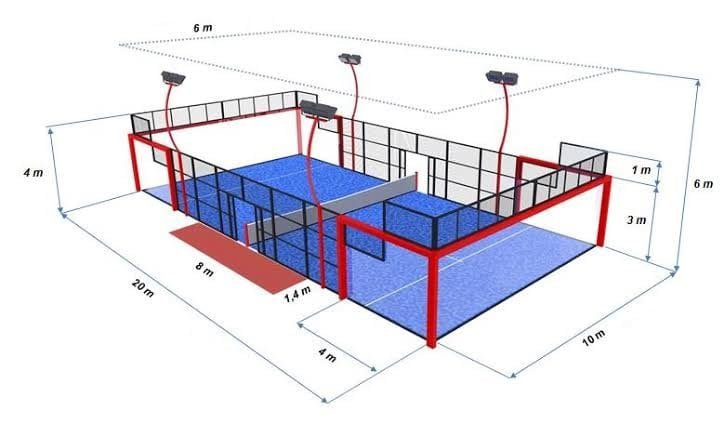
Classic, Panoramic and Full Panoramic doubles courts can all use the standard 20 × 10 m playing area.
The main difference is the structural configuration surrounding the playing enclosure, particularly the amount and location of visible steel support around the glass.
The choice therefore affects:
- Spectator visibility
- Structural appearance
- Project positioning
- Court cost
- Venue aesthetics
It does not fundamentally change the standard playing concept.
Does Panoramic Mean Better?
Not automatically.
A Panoramic or Full Panoramic Court provides better visibility, but a Classic Court may still be the better commercial decision for some projects.
For example:
Classic may be better when:
- Budget is limited
- Several courts are required
- Spectator visibility is not important
- The venue is focused on training or recreational use
Panoramic may be better when:
- The facility is commercially operated
- Spectator experience matters
- The club wants a modern appearance
- A balance between price and presentation is required
Full Panoramic may be better when:
- The court is a centerpiece of the facility
- Events or spectators are important
- Branding and visual presentation have commercial value
- The project is positioned at the premium end of the market
Indoor vs Outdoor Court Selection
The structural type is only one part of the decision.
Indoor Projects
Indoor facilities should also consider:
- Building clear height
- Court spacing
- Structural columns
- Lighting
- Ventilation
- Installation access
- Existing floor conditions
Panoramic courts are often attractive for indoor clubs because the open visual design can make multi-court venues feel less enclosed.
Outdoor Projects
Outdoor projects should consider:
- Wind conditions
- Foundation design
- Drainage
- Corrosion exposure
- Climate
- Surface treatment
The structural configuration should therefore be selected together with the actual installation environment.
How Should a Buyer Choose?
Before selecting a court type, answer these five questions:
- How many courts will the project require?
- What is the target budget per court?
- Is spectator visibility important?
- Is the venue positioned as a standard or premium club?
- Will the court be installed indoors or outdoors?
These five factors normally make the choice between Classic, Panoramic and Full Panoramic much clearer.
PP Courts Court Selection
Classic Padel Court — PP003
Best for projects prioritizing cost efficiency and a traditional reinforced structure.
Panoramic Padel Court — PP002
Best for commercial clubs seeking a balance between spectator visibility, structure and project cost.
Full Panoramic Padel Court — PP001
Best for premium clubs, show courts and projects where maximum visual openness is important.
VIEW FULL PANORAMIC PADEL COURT
Frequently Asked Questions
What is a panoramic padel court?
A panoramic padel court uses fewer visible structural supports around the main glass viewing areas than a traditional framed court, providing improved spectator visibility.
What is the difference between a Classic and Panoramic Padel Court?
A Classic Court uses more visible structural framing. A Panoramic Court reduces some of these support elements to provide a wider spectator view.
What is the difference between Panoramic and Full Panoramic?
A Full Panoramic Court further minimizes visual obstruction around the main viewing areas and is generally positioned as a premium court design.
Is a Panoramic Padel Court more expensive?
It is generally positioned above a Classic Court, but actual price depends on the steel structure, glass, turf, lighting, customization and project specification.
Which court type is best for a commercial club?
For many commercial clubs, Panoramic Courts provide a practical balance between modern appearance, spectator visibility and project cost.
Which court is the most economical?
A Classic Padel Court is generally the most cost-effective of the three main structural designs.
Which court is best for a show court?
A Full Panoramic Court is generally the strongest choice when maximum spectator visibility and premium presentation are priorities.
Can I mix different court types in one padel club?
Yes. Commercial facilities can combine Classic, Panoramic and Full Panoramic Courts according to budget and intended use.
Need Help Choosing a Padel Court?
Send PP Courts your:
- Project country
- Number of courts
- Indoor or outdoor application
- Club positioning
- Budget range
- Preferred court style
We can recommend a suitable court configuration according to your project requirements.