Home > Padel Court News > Padel Court Market Outlook
A manufacturer’s perspective from PP Courts, Tianjin, China. Research reviewed on 14 November 2026.
The global padel court market is expected to keep expanding in 2027, but demand is becoming more uneven across countries. PP Courts’ commercial observations point to slower company sales in Indonesia, stronger Russian-language purchasing interest, and opportunities in the United Kingdom, Germany and Romania. Local approvals and project readiness increasingly matter alongside player demand.
For distributors and club developers, the useful question is therefore more specific than whether padel is growing: which projects have the demand, location and financing to move from an enquiry to an operating venue?
This analysis combines management-reported PP Courts sales and enquiry figures with public sources. Company figures describe our own business experience, not national market totals or independently audited market research.
Is the Global Padel Court Market Still Growing?
The Playtomic and Strategy& Global Padel Report 2026 projects 67,845 courts worldwide in 2026 and 78,700 in 2027, implying approximately 16% growth in the installed court base. However, the report explicitly describes its 2027–2028 figures as indicative projections using a fixed growth assumption, rather than detailed country forecasts. [1]
This supports a positive direction of travel, but it does not establish 16% growth in court manufacturers’ revenue or annual equipment orders. Total installed courts, new courts built during a year and equipment sales are different measures.
A growing global total can coexist with weaker purchasing in individual countries. It can also coexist with more competition between clubs in a particular city. Buyers should use the global outlook as context, then test the economics of their own catchment area.
What PP Courts’ Commercial Data Shows
Our current observations highlight the following signals:
| Company observation | Reported figure or assessment | Interpretation |
|---|---|---|
| Indonesia sales, full year 2025 | 150 court sets | Company sales baseline |
| Indonesia sales, 2026 to the November reporting point | 50 court sets | One-third of the previous full-year total; unequal periods |
| Russian-language purchasing enquiries | Noticeable increase | Company observation, not a national growth estimate |
| Markets receiving particular commercial attention | UK, Germany, Romania, Russia and Central Asia | PP Courts’ assessment, not a global market ranking |
The Indonesia comparison should not be presented as a year-on-year market contraction. Likewise, more enquiries do not automatically mean a proportionate increase in qualified projects or confirmed orders. Advertising spend, targeting and lead classification can affect the result.
Indonesia: From Rapid Orders to More Selective Development
Indonesia was a strong market for PP Courts in 2025, with 150 court sets sold using the reporting baseline adopted here. Company sales reached 50 sets by our November 2026 reporting point.
Our commercial assessment identifies tighter project controls as a major factor behind the slowdown in our orders. Public evidence supports a more specific statement: Jakarta introduced stricter controls on padel development and operation in February 2026.
In its 24 February announcement, the Jakarta provincial government stated that new courts should be located in commercial rather than residential zones. It also addressed building approvals, operating hours and noise, including an 8 p.m. limit for existing residential-area courts and soundproofing where activities disturb residents. [2]
These measures should not be described as a nationwide Indonesian ban. They do show how location and neighbourhood impact can become important constraints after rapid venue expansion.
For buyers, the practical implication is to confirm site suitability before committing to equipment delivery. A court order cannot resolve an unsuitable land use, an unresolved approval or a restricted operating schedule. These issues can change both the opening date and the hours available for paid bookings.
United Kingdom: Strong Demand and Targeted Facility Support
The UK remains a consistently active enquiry market in PP Courts’ experience. There is also independent evidence of substantial participation: on 15 May 2026, the LTA reported one million adults and juniors playing padel in Britain, alongside 1,825 courts across 551 venues. These are dated figures, rather than a live November count. [3]
Public support needs careful explanation. A UK parliamentary answer dated 15 June 2026 confirmed that at least £2.5 million would be invested through the LTA in 2026/27 for covered courts in England serving tennis, padel and other activities. [4]
This is targeted facilities investment. It is not evidence that every private padel club can receive a government grant, or that imported court equipment automatically qualifies for support.
Separately, the LTA states that businesses and existing venues can access support that includes interest-free facility loans of up to £250,000. Applicants must check the current eligibility requirements and application terms. A loan must be distinguished from a grant. [5]
For developers, these signals make covered and community-accessible facilities worth investigating. Our inference is that projects combining local demand, a workable site and a credible operating plan are better positioned than proposals based mainly on an assumed subsidy.
Germany: A Priority Market for Project Preparation
Germany is one of the markets PP Courts currently considers commercially promising. This is our business assessment; we are not assigning it an unsupported national growth rate or claiming that every German city needs more courts.
For a distributor or developer, the next step is to move from country-level interest to a specific project brief. That means identifying the location, indoor or outdoor setting, available space, intended users and local installation responsibilities.
A useful procurement package should define the court configuration, foundations, anchoring, lighting and required technical documentation. Applicable requirements should be checked with the local project team before equipment specifications are finalised.
Indoor proposals also need to establish whether the building is suitable for the intended sporting use. Readers exploring this option can review our indoor padel court information before requesting a project-specific configuration.
Romania: An Opportunity That Needs Local Validation
Romania is another priority in PP Courts’ current market assessment. We see potential for further commercial development, but this article does not provide a verified Romanian market size or national growth forecast.
The opportunity should be tested city by city. Developers should examine competing venues, their prices and booking availability, the local player base, and access to coaching or beginner programmes. Limited existing supply can represent an opening, but it can also mean that demand still needs to be developed.
A phased project may be worth evaluating where demand is uncertain. However, the initial court count should follow a credible operating model rather than an assumption that a smaller venue is always safer.
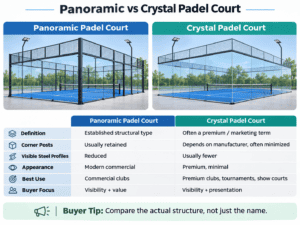
For buyers comparing product options, our panoramic padel court page provides a starting point for discussing configuration and project requirements.
Russia and Central Asia: Growing Russian-Language Interest
PP Courts has observed a noticeable increase in purchasing enquiries from its Russian-language customer segment, including interest in projects in Russia and Central Asia. We treat this as an early commercial signal, not as a verified growth rate for either national court sales or completed installations.
Enquiry language, the customer’s location, the project destination and the acquisition channel are different measures and should be assessed separately.
This distinction matters for Google advertising. Google’s published policies continue to state that ads are paused from serving to users located in Russia. Russian-language enquiries associated with wider marketing activity therefore should not automatically be attributed to ads served inside Russia. [6]
For commercial planning, a stronger measure than enquiry volume alone is the number of buyers able to specify a site, court quantity, budget and installation timetable. Russian-language technical materials may help these conversations, while delivery, payment arrangements and destination-specific requirements must be assessed for each actual order.
How Buyers Should Compare These Markets
Country selection is only the first filter. A viable project needs several conditions to work together:
- Evidence of paying demand. Look beyond social interest to repeat bookings, local pricing and reachable customers.
- A suitable site. Establish the approval route, access, neighbourhood constraints and operating conditions early.
- A complete budget. Separate court supply from freight, import costs, groundworks, installation, utilities and any roof or building work.
- A realistic operating plan. Model utilisation outside peak hours, staffing, coaching and maintenance.
- A deliverable specification. Agree what the supplier provides and what the local contractor must complete.
Our padel court cost guide explains why equipment price and total project cost should be assessed separately. Buyers can also review PP Courts project articles when preparing questions about their own installation environment.
Frequently Asked Questions
Will the padel court market grow in 2027?
The Playtomic and Strategy& 2026 report projects continued growth in global installed courts, at approximately 16% from its 2026 estimate to 2027. This is an indicative forecast using a fixed growth assumption, not a guaranteed increase in equipment sales. [1]
Does PP Courts’ Indonesian sales decline prove the national market is shrinking?
No. The figures describe one manufacturer’s sales over unequal periods. They signal a change in our business, but national conclusions would require broader information on suppliers, new installations and comparable reporting periods.
Has Indonesia banned padel court construction?
The evidence cited here concerns Jakarta’s restrictions on new courts in residential zones and its operational controls. It does not establish a nationwide ban. Buyers should check the requirements for their precise location. [2]
Does the UK government fund padel courts?
There is documented targeted support through the LTA for covered courts in England that can include padel. This does not create universal grant eligibility for commercial projects. LTA interest-free facility loans are a separate support route. [4][5]
Do more Russian-language enquiries mean proportionately higher sales?
No. Enquiries are an earlier stage of the buying process. Conversion rates, project readiness and order size determine their commercial value. The reporting period and changes in marketing activity also need to be considered.
Which market should a new distributor prioritise?
Start with the market where you can validate demand and support delivery, installation and customer service. PP Courts is watching the UK, Germany, Romania and Russian-language opportunities, but the strongest opportunity depends on your local capabilities and actual project pipeline.
The 2027 Outlook: Growth With More Selective Buying
Our padel court market outlook remains positive at a global level, with increasingly selective opportunities at the project level. Indonesia illustrates how stronger controls can affect purchasing activity; Britain combines participation growth with targeted facility support; Germany, Romania and Russian-language enquiries remain areas of commercial interest for PP Courts.
For buyers, the next step is to translate market interest into a workable project. Share your destination, location, court quantity, indoor or outdoor setting and intended opening date so that PP Courts can discuss a suitable configuration and supply scope.
Sources
Company figures reflect PP Courts management-reported sales and commercial observations as of the November 2026 reporting point; they are not national market statistics.
- Playtomic / Strategy& — Global Padel Report 2026, page 26: installed-court forecast and methodology.
- Jakarta Provincial Government — press release, 24 February 2026: new-court zoning, approvals and operating controls.
- LTA — 1,000,000 padel players in Britain, 15 May 2026: dated participation and facility counts.
- UK Parliament — written answer, 15 June 2026: at least £2.5m through LTA for covered facilities in England in 2026/27.
- LTA — support for businesses and existing venues: facility loans up to £250,000 and other support.
- Google — Political content policy: notice about ads paused for users located in Russia.