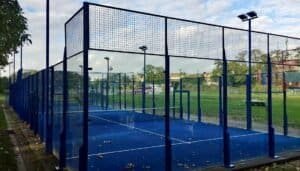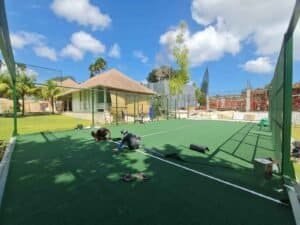
When planning a new padel facility, one of the most critical decisions investors face is choosing between a Standard Double Court and a Single Court. While the game is traditionally played in doubles, the rising demand for 1-on-1 coaching and space-saving solutions has made single courts increasingly popular.
But which option makes the most business sense for your specific project?
As a professional manufacturer of padel courts and roof systems, we have helped countless club owners, hotel operators, and private buyers make this exact decision. In this comprehensive guide, we will break down the differences in target audience, exact dimensions, hidden costs, and logistical considerations to help you maximize your Return on Investment (ROI).
1. Target Audience: Who Are You Building For?
The first step is identifying your core customer base. Single and double courts serve completely different market demands.
The Standard Double Court
The standard 20 × 10 m court is the regulation court defined by the current FIP Rules of Padel and is used for doubles competition.
- Best For: Commercial sports clubs, municipal parks, and large sports complexes.
- The Business Case: Padel is inherently a highly social sport. A standard court maximizes player throughput (4 players per hour), generating higher booking revenues and driving more foot traffic to your club’s bar, restaurant, or pro shop.
The Single Padel Court (1 vs 1)
Designed strictly for two players, this narrower court changes the dynamics of the game.
- Best For: Private luxury villas, boutique hotels, corporate campuses, and urban centers where real estate is extremely expensive.
- The Business Case: It is the perfect solution for padel academies focusing on intensive 1-on-1 coaching. Because the court is narrower, players cannot rely on wide cross-court angles; the game becomes much faster, focusing heavily on volleys, reflexes, and high-intensity cardio.
2. Dimensions & Space Requirements
Land is often the biggest expense in venue development. Understanding the exact footprint is crucial.
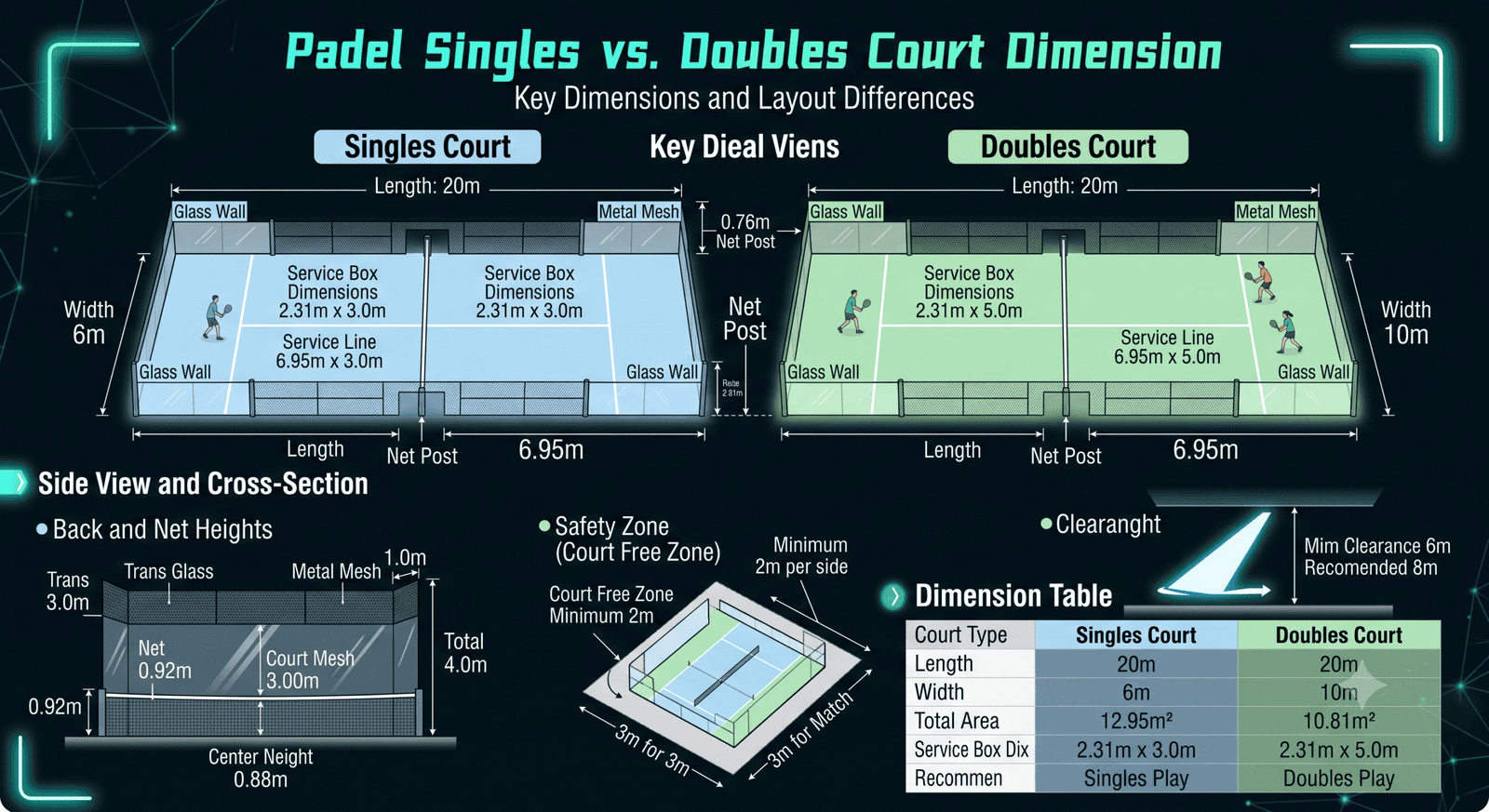
| Feature | Standard Double Court | Single Court |
| Internal Play Area | 20m x 10m | 20m x 6m |
| Total Area (Internal) | 200 sq meters (2,152 sq ft) | 120 sq meters (1,291 sq ft) |
| Recommended Land Size | ~230 – 250 sq meters | ~140 – 160 sq meters |
| Gameplay Format | 2 vs 2 | 1 vs 1 |
Manufacturer’s Pro Tip: Never calculate your land requirement based only on the internal play area. You must leave at least 1.5 to 2 meters of clearance around the exterior perimeter for structural pillars, lighting poles, and player walkways.
3. The Hidden Cost Trap: Is a Single Court 40% Cheaper?
Here is a common misconception among first-time investors: “A single court is 40% smaller in area (120 sqm vs 200 sqm), so it should cost 40% less to buy and build.”
This is entirely false.
While the width is reduced by 4 meters, the length remains exactly 20 meters. This means you still need the exact same amount of side glass panels, side steel pillars, and lighting structures as a standard court.
The only materials you save on are:
- 4 meters of back glass and steel mesh per side.
- 80 square meters of artificial turf.
- Shorter horizontal steel beams at the baseline.
The Reality: For many commercial clubs with sufficient space, a standard doubles court can offer stronger revenue potential because it accommodates four players per booking. However, the best ROI depends on local demand, land cost, booking prices and the club’s business model.
4. International Logistics & Container Loading
When importing padel courts directly from a manufacturer, freight optimization is a major part of your total landed cost.
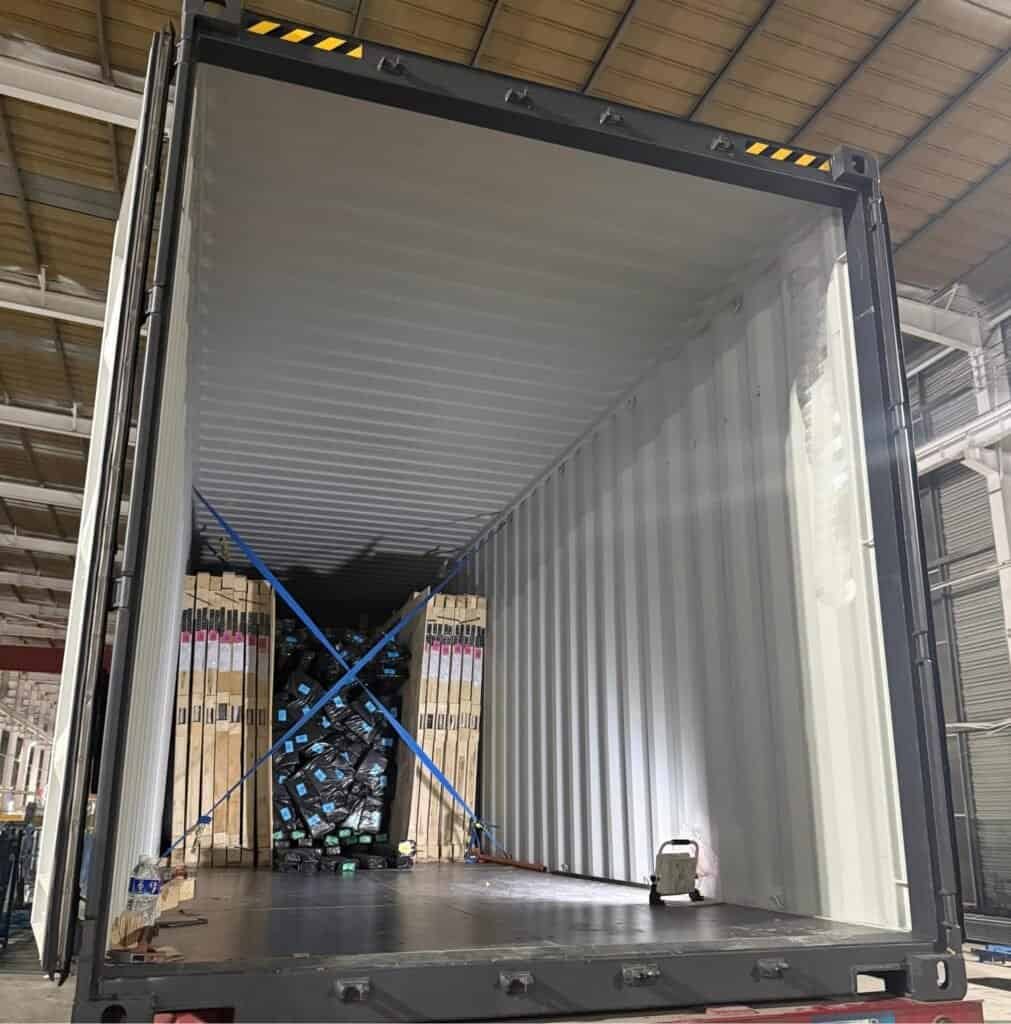
Because standard and single courts require different volumes of steel and glass, they pack differently into standard 40ft High Cube (HQ) containers. As experienced exporters shipping globally from major hubs like Tianjin Port, our logistics team utilizes custom A-frame steel racks to pack courts densely and safely. If you are ordering multiple courts, mixing single and double courts in one container can sometimes optimize the dead space, significantly lowering your average shipping cost per court.
5. Roof Systems: Engineering for Different Spans
If you are building an outdoor court, protecting it from rain and extreme sun is essential for continuous revenue. This is where the structural differences between single and double courts become an advantage.
- Standard Courts (10m width): Require a robust, high-arch prefabricated roof system to safely clear the 10-meter span while maintaining the FIP-mandated 6-meter vertical play height.(FIP requires a minimum unobstructed height of 6 meters, while 8 meters is recommended for new facilities.)
- Single Courts (6m width): Because the span is much shorter, the engineering requirements for the roof trusses are simpler. Installing a canopy over a single court is highly cost-effective, making it a brilliant upgrade for private villa owners who want a weather-proof playing experience year-round.
Frequently Asked Questions About Singles vs Doubles Padel
Is a singles padel court the same as a doubles court?
No. A standard doubles padel court measures 20 × 10 m and is designed for four players. Commercial singles or 1v1 courts are commonly built in a narrower 20 × 6 m format for two players.
The current FIP Rules of Padel define the official court as 20 × 10 m and the rules are written around pairs of players. The 20 × 6 m singles court should therefore be described as a commercial 1v1 format, not an official FIP competition court. Padel FIP
How are doubles different from singles padel?
The biggest differences are court width, number of players and playing style.
| Feature | Singles Padel | Doubles Padel |
|---|---|---|
| Players | 1 vs 1 | 2 vs 2 |
| Typical Court Format | 20 × 6 m | 20 × 10 m |
| Court Coverage | One player covers the full side | Two players share each side |
| Playing Style | Faster, more individual movement | More positioning and teamwork |
| Best For | Coaching, private use, limited space | Clubs, social play, official competition |
Singles emphasizes individual movement and court coverage, while doubles places more emphasis on positioning, communication and controlling the net as a pair.
Why is padel usually played as doubles?
Padel was developed primarily as a doubles sport, and current FIP competition rules are based on two pairs of players using a 20 × 10 m court. The official rules repeatedly refer to each side as a “pair,” including serving, receiving and scoring procedures. Padel FIP
Doubles also suits the enclosed-court design well because four players can use the walls, angles and net positioning strategically.
Singles padel does exist recreationally and commercially, but it is not the standard FIP competition format.
Can two people play padel on a doubles court?
Yes. Two players can use a standard 20 × 10 m doubles court for recreational 1v1 practice.
However, the court is much wider for one player to cover, so the game becomes more physically demanding and the playing patterns are different from normal doubles padel.
For regular 1v1 coaching or private play, a narrower singles court is usually more practical.
Can I play singles padel on a doubles court?
Yes, but it should be treated as recreational singles play rather than the standard competition format.
On a 20 × 10 m doubles court, each player has to cover significantly more lateral space. This can be useful for fitness or training, but it does not reproduce the playing experience of a purpose-built 20 × 6 m single padel court.
For clubs offering frequent one-to-one coaching, a dedicated singles court can make better use of space.
Are doubles harder than singles padel?
Neither format is automatically harder; they challenge players in different ways.
Singles padel generally requires more individual court coverage, movement and physical endurance.
Doubles padel requires stronger positioning, communication, net control and coordination with a partner.
For beginners, doubles is often more forgiving physically because two players share each side of the court, while singles can become physically demanding very quickly.
Is there an official FIP singles padel court size?
The current FIP Rules of Padel define the regulation court as 20 × 10 m. They do not establish a separate 20 × 6 m official competition court in the general Rules of Padel.
The 20 × 6 m format is widely used commercially for 1v1 padel, coaching and space-limited projects, but it should not be presented as an official FIP singles competition size.
Which is better for a commercial club: singles or doubles?
For most commercial clubs, a standard doubles court is usually the primary choice because it supports four players and matches the official competition format.
A singles court works better as a complementary product for one-to-one coaching, private training or narrow spaces where a standard 20 × 10 m court cannot fit.
For larger clubs, a practical layout can combine several doubles courts with one dedicated singles training court.
Final Verdict
If your goal is commercial profitability and you have the land, the Standard Double Court is always the undisputed king. However, if you are an elite coach, a luxury hotelier, or an investor with an odd-shaped, narrow plot of land, the Single Court offers a premium, high-intensity padel experience that fits perfectly into tight spaces.
Need a compact court for 1v1 training or a limited-space project? Explore our PP004 Single Panoramic Padel Court for specifications, configuration options and factory pricing.