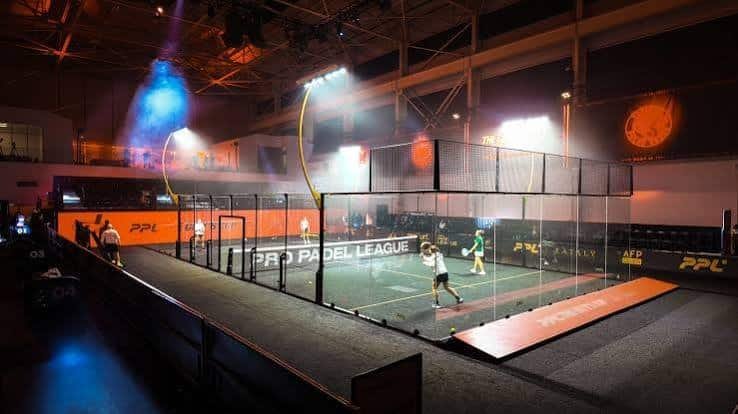
A padel court may look similar to a small tennis court at first glance, but its design and playing characteristics are very different.
The most recognizable features of a padel court are its enclosed structure, glass rebound walls, metal fencing, artificial turf and compact 20 × 10 m playing area.
Unlike tennis, the surrounding walls are part of the game. Players can continue a rally after the ball rebounds from the glass, making the court itself an active part of how padel is played.
The International Padel Federation specifies a standard playing area of 20 m × 10 m, divided in half by a central net.
Below are the main features that define a modern padel court.
1. A Padel Court Is Fully Enclosed
One of the clearest differences between padel and tennis is the enclosure.
A tennis court has open boundaries around the playing area.
A padel court is completely enclosed by a combination of:
- Rebound walls
- Glass panels
- Metallic mesh
- Steel structure
The FIP rules state that the court must be completely enclosed, with rebound walls and metallic fencing forming part of the court boundaries.
This enclosure is not only structural.
It directly affects gameplay because the ball can interact with the surrounding walls.
2. The Walls Are Part of the Game
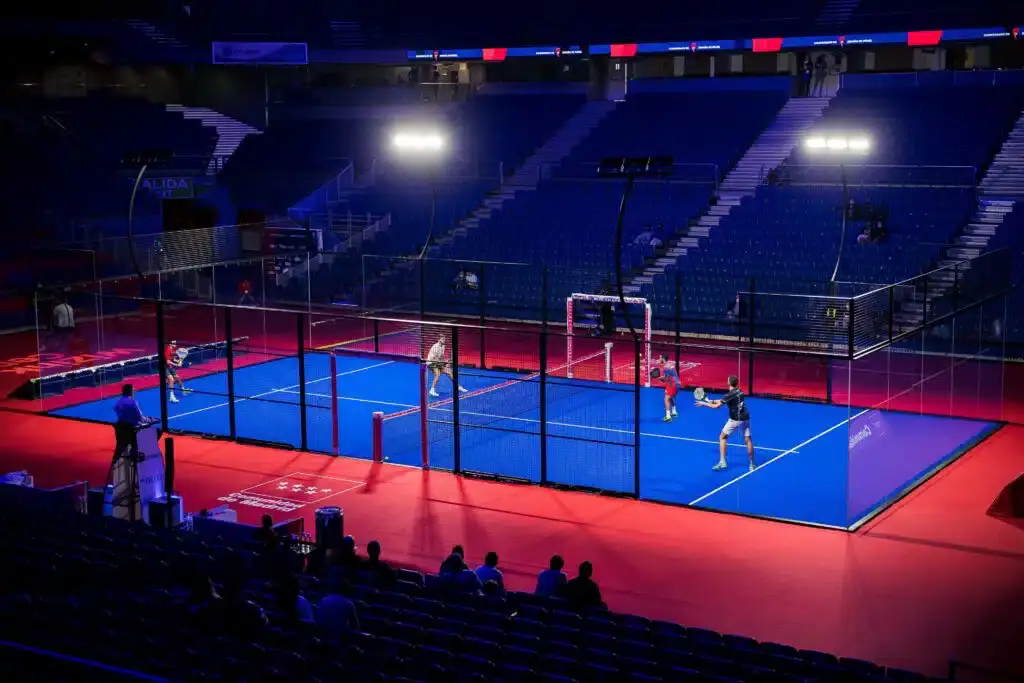
This is probably the most distinctive feature of padel.
In tennis, once the ball passes beyond the playing area, the point normally ends.
In padel, the ball can rebound from the walls and remain in play.
The rebound surface must therefore be:
- Hard
- Smooth
- Uniform
- Suitable for consistent ball rebound
FIP regulations allow the walls to be made from transparent or solid materials, including glass, provided the surface produces a consistent rebound.
Modern commercial courts commonly use tempered glass because it combines playing performance with spectator visibility.
3. A Padel Court Is Much Smaller Than a Tennis Court
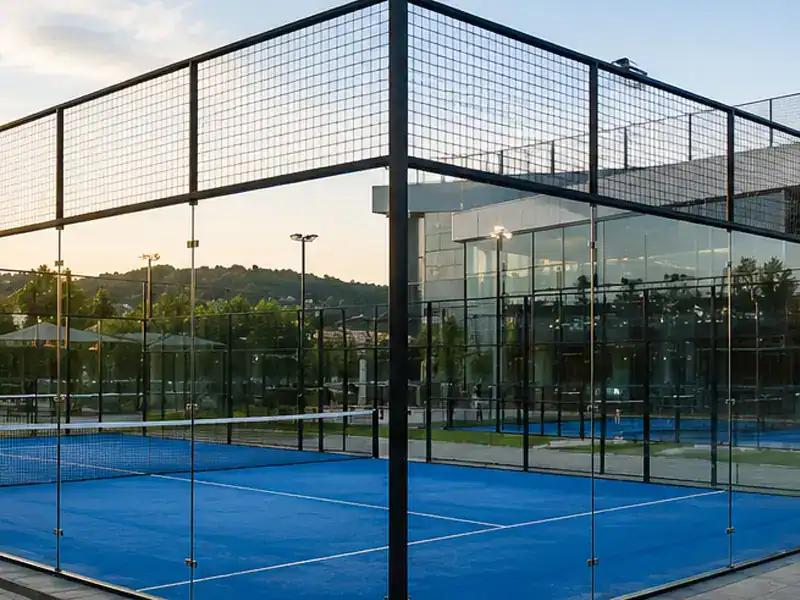
A standard doubles padel court measures:
20 m long × 10 m wide
This gives a total playing area of approximately:
200 m²
The LTA describes a padel court as being roughly one-third the size of a tennis court.
The smaller playing area is one reason padel feels faster and more compact.
Players are closer to:
- Their partner
- Their opponents
- The net
- The surrounding walls
This creates a more continuous and tactical style of play.
4. Padel Is Designed Mainly for Doubles
The standard 20 × 10 m court is primarily designed for:
2 vs 2 play
This is another important difference from tennis, where both singles and doubles are commonly played on the same basic court.
Padel’s compact dimensions and enclosed walls make doubles the standard format.
Single padel courts also exist, usually using a narrower layout, but the standard international court is the 20 × 10 m doubles format.
5. Glass Walls Provide Both Rebound and Visibility
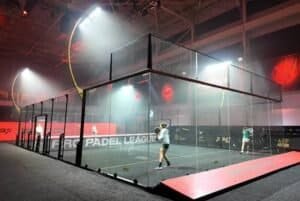
Modern padel courts commonly use transparent tempered glass around the main rebound areas.
Glass serves two purposes.
Playing Function
The ball can rebound from the glass and continue in play.
Spectator Function
Transparent walls allow people outside the court to watch the game clearly.
This is one of the reasons padel works particularly well in:
- Clubs
- Resorts
- Sports centers
- Show courts
- Tournament venues
The reference article from Padel Lux also identifies high-quality tempered glass as one of the core characteristics of a professional padel court, particularly because the glass must provide consistent rebounds while maintaining safety.
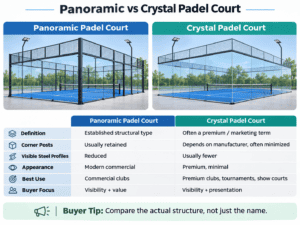
6. Panoramic Designs Improve the Viewing Experience
Traditional padel courts use more visible steel framing around the glass.
Modern panoramic designs reduce some of these visual obstructions.
Common court styles include:
- Classic
- Panoramic
- Full Panoramic
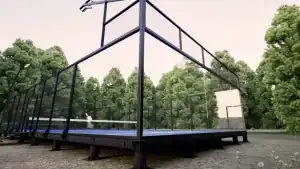
A panoramic court provides wider views through the glass.
A full panoramic court can further reduce or remove corner posts, creating a cleaner viewing line around the court.
This does not change the basic rules of padel.
Instead, it improves:
- Spectator visibility
- Camera visibility
- Court appearance
- Club presentation
This is why panoramic designs are often used in premium commercial projects and center courts.
7. Artificial Turf Is Commonly Used as the Playing Surface
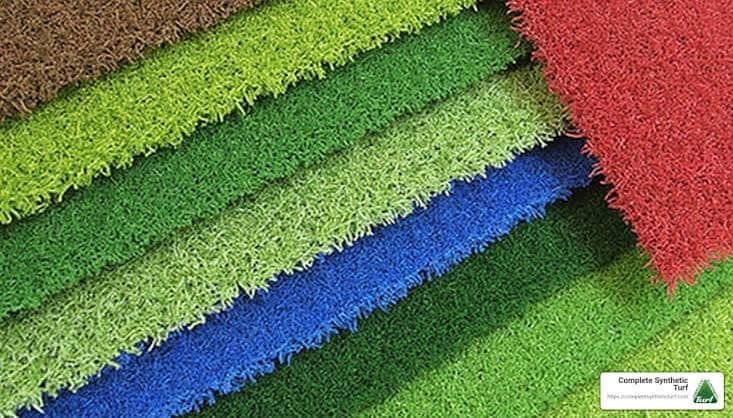
Another recognizable padel court feature is the artificial turf surface.
Unlike tennis, where courts may use clay, grass or hard surfaces, commercial padel courts commonly use specialized artificial turf.
The turf influences:
- Player grip
- Sliding
- Ball speed
- Ball bounce
- Playing comfort
Sand is also commonly distributed within the turf system.
The goal is to create a surface that allows players to move quickly while still maintaining controlled grip.
Padel Lux also identifies specialized artificial turf as a defining feature of a professional court because the surface must balance grip and sliding movement.
8. Metal Mesh Completes the Enclosure
A padel court is not surrounded entirely by glass.
Metallic fencing completes the enclosure around parts of the sides and above the rebound walls.
According to FIP rules, the ends of the court reach a total height of 4 m, with the lower section acting as the rebound wall and metallic fencing above.
The mesh has several functions:
- Keeps the ball inside the court
- Completes the enclosure
- Allows airflow
- Maintains visibility
- Forms part of the playable boundary
The combination of glass + mesh is one of the most recognizable visual characteristics of a padel court.
9. The Net Is Lower Than Many People Expect
Like tennis, padel uses a central net.
However, the dimensions are specific to padel.
The official net is:
- 10 m long
- 0.88 m high at the center
- 0.92 m high at the ends
These measurements are defined by FIP regulations.
The lower net contributes to the fast, close-range style of play.
10. Lighting Is Usually Integrated Into the Court Structure
Many commercial padel courts include lighting directly around the court structure.
This allows clubs to operate:
- In the evening
- Indoors
- During low-light conditions
Lighting must provide good visibility without creating excessive glare on the glass.
Modern courts often use LED fixtures mounted on dedicated light poles or integrated structural supports.
The reference Padel Lux guide also identifies professional lighting as an important padel court feature because poor positioning can create glare and shadows during play.
11. The Court Structure Is More Important Than It Looks
Although the glass and turf are the most visible components, the steel structure supports the entire enclosure.
The structure connects:
- Glass
- Mesh
- Lighting
- Doors
- Base plates
- Anchors
For outdoor projects, the court structure must also account for environmental conditions such as wind and corrosion.
This is why an outdoor padel court is not simply an indoor court placed outside.
The structural system must match the installation environment.
12. Modern Padel Courts Are Highly Customizable
Padel courts can be customized much more than many traditional sports courts.
Common options include:
- Steel frame colors
- Turf colors
- Club logos
- Sponsor branding
- Glass branding
- LED lighting styles
- Panoramic structures
- Roof systems
This makes padel particularly attractive for commercial clubs and hospitality projects where the court is part of the overall visual identity of the venue.
Padel Court vs Tennis Court
The easiest way to understand the features of a padel court is to compare it directly with tennis.
| Feature | Padel Court | Tennis Court |
|---|---|---|
| Standard Playing Area | 20 × 10 m | Larger |
| Main Format | Doubles | Singles & Doubles |
| Enclosure | Fully enclosed | Open |
| Walls Used in Play | Yes | No |
| Rebound Walls | Glass / solid surface | No |
| Metal Fencing | Part of court enclosure | Usually perimeter only |
| Surface | Commonly artificial turf | Hard, clay, grass etc. |
| Central Net | Yes | Yes |
| Spectator Viewing | Through glass | Open perimeter |
| Panoramic Designs | Common | Not typical |
The main difference can be summarized very simply:
A tennis court defines the playing area with lines.
A padel court defines the playing area with both lines and walls.
What Does a Complete Padel Court Include?
Although court designs vary, a complete commercial padel court normally includes:
- Steel structure
- Rebound glass
- Metallic mesh
- Artificial turf
- Central net
- Doors or entrances
- Lighting
- Base plates and anchors
- Foundation
Each component contributes to either gameplay, safety or structural stability.
Classic, Panoramic and Full Panoramic Courts
Not every padel court looks exactly the same.
Classic Padel Court
Uses more visible structural posts and framing.
Best suited to projects that prioritize traditional structural support.
Panoramic Padel Court
Reduces visual obstruction around the main viewing areas.
Provides a more open spectator experience.
Full Panoramic Padel Court
Further reduces structural obstruction, especially around the glass corners.
Designed for maximum viewing visibility and premium commercial presentation.
The playing rules remain the same.
The difference is mainly in the structural design and viewing experience.
Why These Features Matter
A padel court is more than a small tennis court.
Its defining characteristics work together:
Compact dimensions make the game fast.
Glass walls keep the ball in play.
Metal fencing completes the enclosure.
Artificial turf controls player movement and ball behavior.
The central net divides the playing area.
Panoramic structures improve visibility.
Together, these elements create the unique playing environment that distinguishes padel from other racket sports.
Frequently Asked Questions
What are the main features of a padel court?
The main features are an enclosed 20 × 10 m playing area, rebound walls, glass panels, metallic fencing, artificial turf and a central net.
Why does a padel court have glass walls?
The glass acts as a rebound surface while also allowing spectators to see into the court.
Are the walls part of padel gameplay?
Yes. The ball can rebound from the permitted walls and remain in play.
How big is a padel court?
A standard doubles court measures 20 × 10 m.
Is a padel court smaller than a tennis court?
Yes. The LTA describes a padel court as approximately one-third the size of a tennis court.
What surface is used on a padel court?
Artificial turf is commonly used on commercial courts.
Is padel mainly singles or doubles?
Standard padel is mainly played as doubles, with four players on a 20 × 10 m court.
What is a panoramic padel court?
A panoramic padel court reduces structural obstruction around the glass to improve spectator visibility.
Understanding the Padel Court Before Choosing One
The most important features of a padel court are not individual specifications such as glass thickness or steel size.
They are the characteristics that define how the sport is played:
- Enclosed playing area
- Rebound walls
- Compact size
- Glass visibility
- Artificial turf
- Mesh fencing
- Doubles-focused layout
- Panoramic viewing
Once these basic features are understood, buyers can then compare different court designs such as Classic, Panoramic, Full Panoramic, Single or premium commercial configurations.