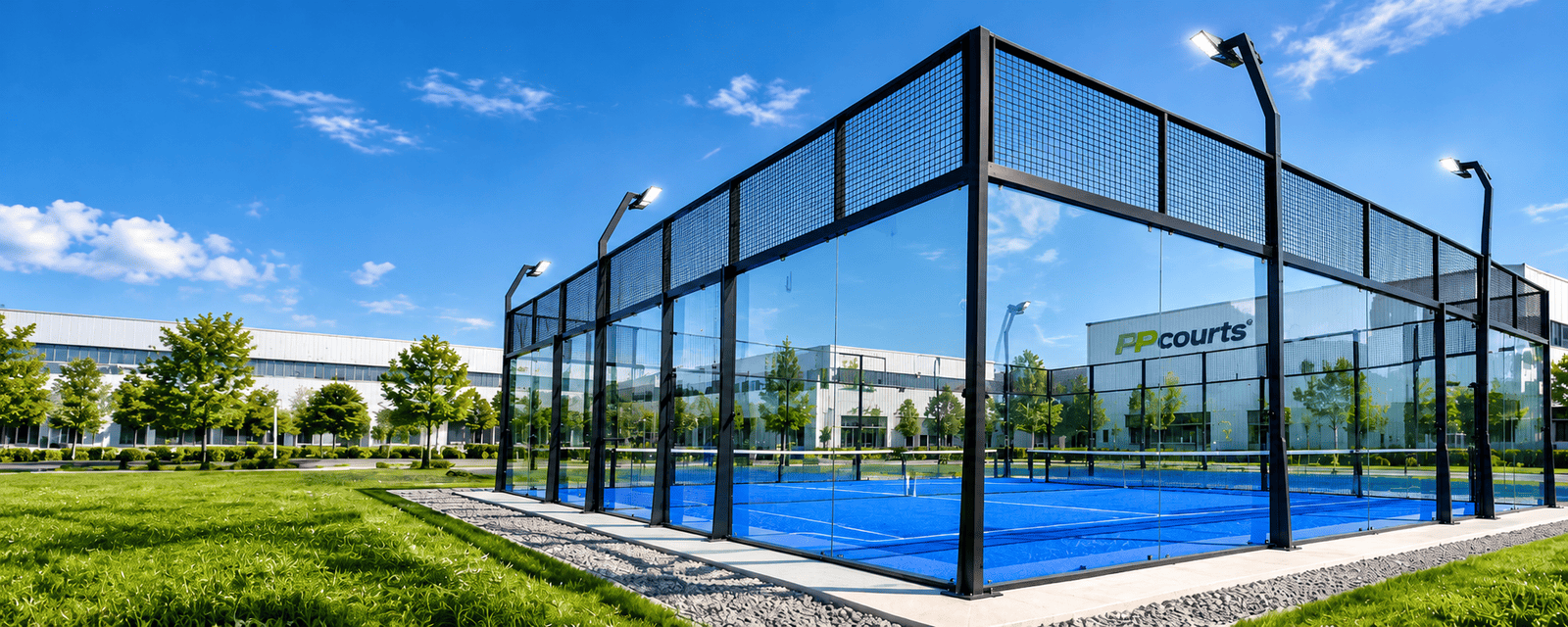
1. What Are Padel Court Walls?
Padel court walls are a functional part of the playing system, not simply an enclosure.
A complete padel court wall system normally includes:
- Tempered glass panels
- Steel support structure
- Metal mesh fencing
- Glass fixing hardware
- Base plates
- Anchor bolts
- Concrete foundation
The wall system must provide a consistent rebound surface while also supporting spectator visibility, structural stability and safe long-term operation.
2. Why Are Glass Walls Used in Padel Courts?
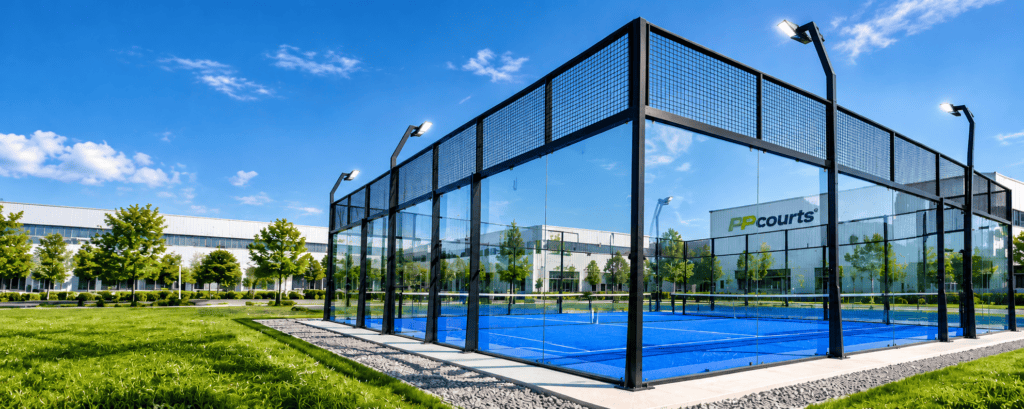
Glass walls are widely used because they combine playing performance with visibility.
Main benefits include:
- Clear spectator viewing
- Wide panoramic sightlines
- Better visibility for coaches and cameras
- Premium commercial appearance
- Consistent rebound surface
- Improved visibility around show courts and center courts
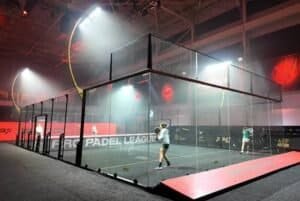
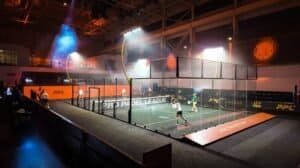
For panoramic court designs, the glass perimeter can provide a nearly 360° all-around viewing experience with minimal visual obstruction.
However, visibility should never be considered independently from structural safety.
Glass thickness, glass weight, support posts, steel structure and foundation all need to work together.
3. Padel Court Glass Size and Weight
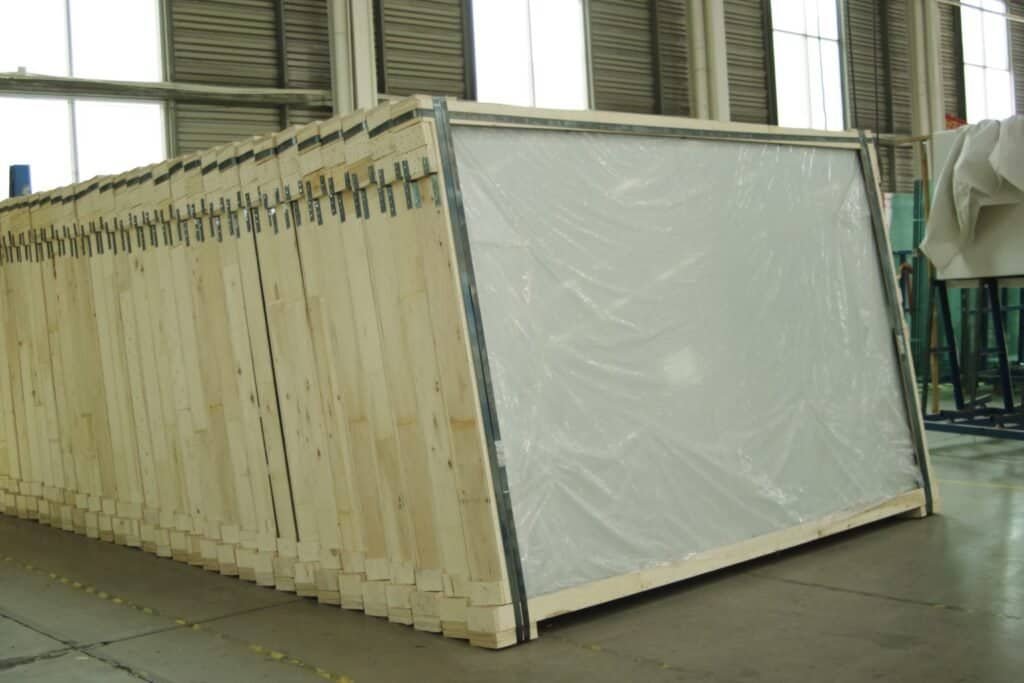
PP Courts commonly uses large tempered glass panels measuring:
1995 × 2995 mm
Typical single-panel weight:
| Glass Thickness | Approx. Weight per Panel |
|---|---|
| 10 mm | Approx. 150 kg |
| 12 mm | Approx. 180 kg |
Because every glass panel is large and heavy, the wall system must be designed according to the actual load transferred through the glass, steel frame, base plate and foundation.
Glass thickness alone should never be used to judge the quality of a padel court wall.
4. 10 mm vs 12 mm Padel Court Glass
Both 10 mm and 12 mm tempered glass may be used depending on the court configuration and project requirements.
10 mm Tempered Glass
- Approx. 150 kg per panel
- Lower individual panel weight
- Easier handling during installation
- Can be suitable for selected court configurations
12 mm Tempered Glass
- Approx. 180 kg per panel
- Higher stiffness
- Commonly used in premium and panoramic courts
- Requires greater attention to support structure, fixing and installation
For full panoramic, Ultra and Super Panoramic systems, PP Courts generally focuses on 12 mm glass configurations.
5. Padel Court Glass Walls and 360° Visibility
One of the main advantages of panoramic glass walls is improved viewing visibility.
A reduced-obstruction glass wall allows spectators to see the playing area from more angles.
For premium panoramic systems, this can create a 360° viewing experience with very limited blind spots.
However, not every panoramic padel court uses the same structural design.
The main difference is whether corner support posts are retained or removed.
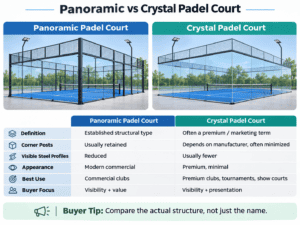
6. Panoramic Padel Court With Corner Posts
The standard Panoramic Padel Court uses corner posts.
The corner posts provide additional support around the glass perimeter while still allowing wide spectator visibility.
Main characteristics:
- Panoramic glass viewing area
- Corner posts retained
- Additional structural support
- Flexible indoor and outdoor application
- Good balance between visibility and structural efficiency
- Lower engineering complexity than a cornerless system
This configuration is suitable for commercial clubs that want strong panoramic visibility without completely removing the corner steel structure.
7. Full Panoramic Padel Court Without Corner Posts
The Full Panoramic Padel Court removes the corner posts.
This creates cleaner sightlines and a more open glass perimeter.
Main characteristics:
- No corner posts
- Improved 360° viewing
- Reduced visual obstruction
- Premium commercial appearance
- Greater dependence on surrounding steel structure
- More demanding glass fixing and anchoring design
Because each 12 mm glass panel weighs approximately 180 kg, removing corner posts requires careful structural coordination.
8. Ultra Panoramic Padel Court Walls
The Ultra Panoramic Padel Court also uses a corner-post-free design.
Its main positioning is structural reinforcement.
Typical characteristics include:
- No corner posts
- 12 mm tempered glass
- Reinforced structural configuration
- Heavy-duty steel design
- Double mesh system
- Suitable for high-intensity commercial use
The Ultra model focuses more strongly on reinforced structure rather than only premium appearance.
9. Super Panoramic Padel Court Walls
The Super Panoramic Padel Court is also designed without corner posts.
Its main positioning is a premium integrated specification package.
Typical features may include:
- 12 mm premium tempered glass
- Corner-post-free panoramic design
- Reinforced steel
- Premium turf
- Advanced LED lighting
- Enhanced corrosion protection
- Premium hardware
- Custom branding
- Optional roof integration
The Super model is designed for flagship commercial projects where overall court specification and appearance are both important.
10. Comparison of Padel Court Wall Designs
| Court Type | Corner Posts | Typical Glass | Main Advantage |
|---|---|---|---|
| Classic | Yes | 10 / 12 mm | Maximum structural support |
| Panoramic | Yes | 10 / 12 mm | Visibility + structural balance |
| Full Panoramic | No | 12 mm | Maximum panoramic visibility |
| Ultra Panoramic | No | 12 mm | Reinforced structural performance |
| Super Panoramic | No | 12 mm | Premium integrated specification |
11. Why Cornerless Glass Walls Require More Engineering
Removing the corner posts improves visibility, but it also changes how structural forces are transferred.
For example, one 12 mm glass panel measuring 1995 × 2995 mm weighs approximately 180 kg.
The complete system must therefore consider:
- Glass self-weight
- Player impact
- Ball impact
- Steel frame stiffness
- Glass fixing points
- Base plate strength
- Anchor bolts
- Concrete foundation
- Indoor or outdoor environment
- Wind load for outdoor projects
The objective is not simply to remove steel posts.
The objective is to achieve better visibility while maintaining a safe and stable wall system.
12. Indoor vs Outdoor Padel Court Walls
Indoor and outdoor glass walls should not automatically use the same structural configuration.
Indoor Padel Court Walls
Indoor courts are generally less affected by wind.
This allows greater flexibility when designing panoramic and cornerless structures.
Main considerations include:
- Glass weight
- Player impact
- Structural rigidity
- Ceiling height
- Fixing accuracy
- Installation access
Indoor projects may allow fewer visible support elements depending on the structural design.
Outdoor Padel Court Walls
Outdoor courts require additional consideration because the glass acts as a large solid surface exposed to wind.
Main considerations include:
- Local wind conditions
- Structural reinforcement
- Support-post arrangement
- Anchor strength
- Foundation design
- Corrosion protection
- Rain and drainage
- Coastal exposure
In some outdoor projects, additional support may be more important than maximizing visual openness.
13. Do Padel Courts Need Corner Posts?
The answer depends on the court design.
Panoramic Court
Yes. PP Courts’ Panoramic model uses corner posts.
Full Panoramic Court
No. The corner posts are removed.
Ultra Panoramic Court
No. It uses a cornerless design.
Super Panoramic Court
No. It also uses a cornerless panoramic design.
A no-corner-post design is not automatically better for every project.
The correct solution depends on the installation environment, structure, foundation and project requirements.
14. Glass Fixing System
The safety of a glass wall depends heavily on how the glass is connected to the steel structure.
Important factors include:
- Accurate factory-drilled holes
- Correct fixing-point positions
- Premium bolts and hardware
- Rubber or EPDM isolation
- No direct glass-to-steel contact
- Controlled bolt tightening
- Consistent panel spacing
- Accurate steel-frame alignment
Poor fixing accuracy can create uneven stress in the glass and make installation more difficult.
15. Steel Frame and Glass Must Be Designed Together
Padel court glass should never be treated as an independent component.
The complete structural load path is:
Glass → Fixing Hardware → Steel Frame → Base Plate → Anchors → Foundation
If one part of this system is weak, the performance of the whole wall system may be affected.
This is particularly important for full panoramic and cornerless designs.
16. Foundation and Anchoring
The wall structure ultimately transfers loads into the foundation.
Important foundation considerations include:
- Concrete strength
- Slab thickness
- Anchor type
- Anchor spacing
- Base plate size
- Embedded or post-installed anchors
- Drainage
- Level tolerance
- Local structural requirements
Foundation design should be coordinated before court installation begins.
17. Glass Wall Padel Court vs Traditional Framed Court
| Feature | Traditional / Classic | Panoramic Glass Wall |
|---|---|---|
| Visual Obstruction | More visible steel | Reduced |
| Spectator View | More limited | Wider |
| Corner Posts | Normally yes | Depends on model |
| Structural Simplicity | Higher | More engineering required |
| Premium Appearance | Standard | Higher |
| Outdoor Adaptability | Easier to reinforce | Requires careful load design |
| Best Application | Standard commercial courts | Premium clubs and show courts |
18. What Buyers Should Check Before Ordering Padel Court Glass Walls
Before purchasing a glass wall padel court, buyers should confirm:
- Glass panel dimensions
- Glass thickness
- Weight per panel
- Tempered glass standard
- Glass edge treatment
- Glass drilling accuracy
- Corner-post configuration
- Steel section
- Base plate design
- Anchor system
- Indoor or outdoor use
- Local wind conditions
- Corrosion protection
- Replacement glass availability
- Installation documentation
A professional quotation should specify both the glass system and the supporting structure.
19. Glass Wall Replacement and Maintenance
Padel court glass walls should be inspected regularly.
Recommended checks include:
- Loose fixing bolts
- Damaged rubber gaskets
- Glass cracks or edge damage
- Steel frame movement
- Corrosion around connection points
- Base plate movement
- Anchor condition
Individual glass panels can normally be replaced if the correct dimensions and drilling pattern are available.
Keeping the original glass drawing and hole-position data can make future replacement much easier.
20. Which Padel Court Wall Design Should You Choose?
Choose Panoramic if:
You want wide visibility while retaining corner-post support.
Choose Full Panoramic if:
You want maximum visual openness and a cornerless appearance.
Choose Ultra Panoramic if:
You need a reinforced structural flagship configuration.
Choose Super Panoramic if:
You want a premium complete system with upgraded glass, steel, turf, lighting and corrosion protection.
The correct choice should depend on the actual project environment rather than appearance alone.
FAQ
How thick is padel court glass?
Common configurations include 10 mm and 12 mm tempered glass.
How much does one padel court glass panel weigh?
For a 1995 × 2995 mm panel, approximately 150 kg for 10 mm glass and approximately 180 kg for 12 mm glass.
Are padel court walls made of tempered glass?
Yes, tempered safety glass is commonly used for padel court rebound walls.
Do panoramic padel courts have corner posts?
Some do and some do not. PP Courts’ Panoramic model uses corner posts, while Full, Ultra and Super Panoramic models use cornerless designs.
Why are some outdoor panoramic courts reinforced?
Outdoor glass walls are exposed to wind loads, so additional structural reinforcement may be required depending on the project location.
Is 12 mm glass always better than 10 mm glass?
Not necessarily. Glass thickness should be selected together with the steel structure, fixing system, foundation and application environment.
Can a broken glass panel be replaced?
Yes. Individual panels can normally be replaced if the dimensions, thickness and drilling pattern are correctly matched.
What is the main advantage of a glass wall padel court?
The main advantage is combining a playable rebound surface with improved spectator visibility and a premium panoramic appearance.